The Robert T. Stafford Disaster Relief and Emergency Assistance Act is the law that turns a state disaster into a federal one. It gives the president two instruments: a major disaster declaration, which unlocks the broadest aid for individuals and public infrastructure, and an emergency declaration, which provides limited help to save lives and protect property before or immediately after an event. Every federal disaster response you have seen — FEMA trailers, individual assistance checks, debris removal contracts — exists because a governor requested it and the president declared it under the Stafford Act, which Congress passed in 1988 building on the Federal Disaster Relief Act of 1950.
What is the difference between a major disaster declaration and an emergency declaration?
A major disaster declaration is the heavier tool. It can authorize Individual Assistance for affected households — temporary housing, home repair, and other needs not covered by insurance — plus Public Assistance to state, local, tribal, and some nonprofit owners of damaged infrastructure, and Hazard Mitigation Grant Program funding to reduce future risk. The Stafford Act definition ties major disasters to natural catastrophes or, regardless of cause, fires, floods, or explosions severe enough to warrant federal help. An emergency declaration is narrower: directed assistance to save lives, protect property and public health, and lessen the threat, historically used for events like disease outbreaks, utility failures, and pre-landfall preparation. Emergency declarations can provide direct federal help but do not open the full individual assistance machinery.
How does a declaration actually happen?
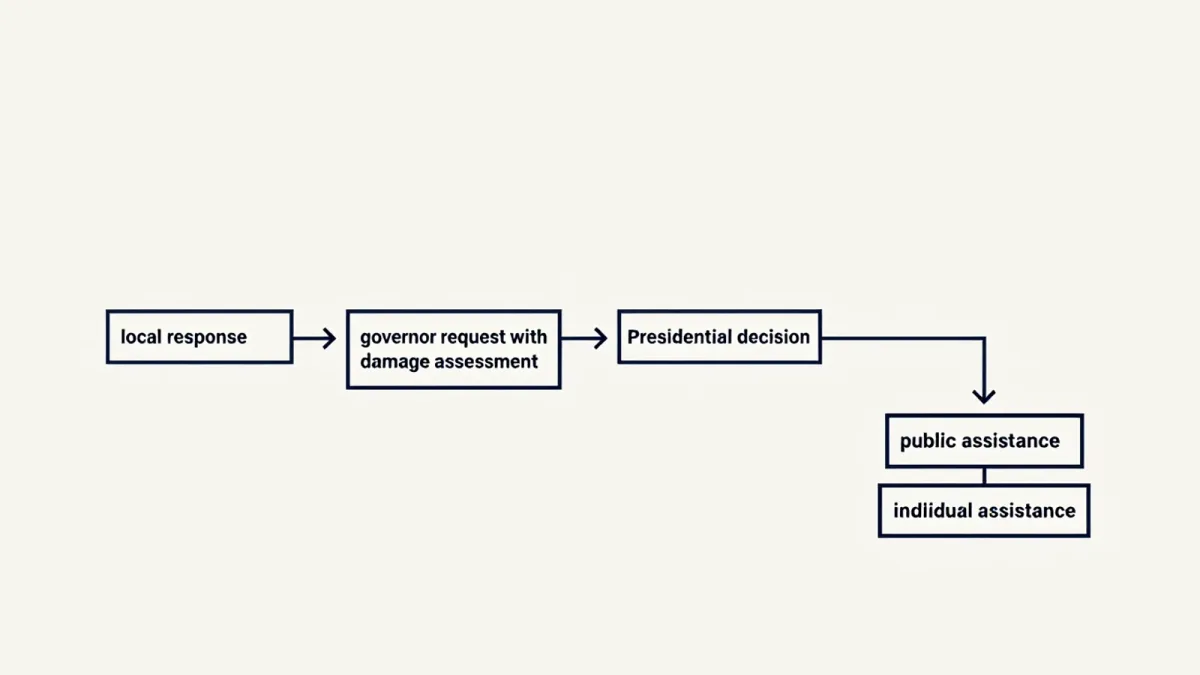
The sequence is fixed. The governor — or chief executive of a tribe requesting directly, since the 2018 reauthorization allowed tribal requests to bypass the state — assesses damage and determines that state and local capacity is exceeded. FEMA and the state conduct joint preliminary damage assessments, though the president may waive them in clearly severe cases. The governor submits a written request specifying the counties and the assistance programs sought, and the president decides. The declaration, if granted, designates which counties are included — help flows only to designated areas, and additional counties can be added later. Neither the Stafford Act nor FEMA's regulations set a dollar threshold guaranteeing approval; the decision is presidential discretion informed by the damage assessment and the state's capability.
Who pays, and in what shares?
Public Assistance under a major disaster declaration is cost-shared, with the federal government covering at least 75 percent of eligible costs and the state and locals the rest. Presidents can raise the federal share — to 90 or 100 percent for some categories in especially severe events — and have done so after major hurricanes. Individual Assistance programs also carry cost-sharing terms, such as minimum percentages for some housing repair programs. Hazard mitigation funds typically require a nonfederal match as well. The point of the 75 percent floor is that federal help is substantial but never entirely free: states budget for their share before requesting a declaration.
| Emergency declaration | Major disaster declaration | |
|---|---|---|
| Purpose | Save lives, protect property, avert the threat | Full recovery: people, infrastructure, mitigation |
| Individual Assistance | Generally not available | Available if designated |
| Public Assistance | Limited categories, often debris and emergency work | Broad categories including permanent work |
| Trigger events | Any catastrophe, including non-natural | Natural catastrophes; fire, flood, or explosion regardless of cause |
What does a declaration mean for survivors?
Once a county is designated for Individual Assistance, affected residents can register with FEMA by phone or online. Aid may include temporary housing assistance, home repair or replacement grants for owner-occupants, and other needs such as medical or transportation costs; these grants do not repay insurance and are not loans. Survivors may also qualify for low-interest disaster loans from the Small Business Administration, which FEMA refers applicants to. Designation matters geographically: residents of adjacent, undesignated counties are not eligible until their county is added, which is why governors ask for expanded designations as assessments continue.
What programs fall under Public Assistance?
Public Assistance reimburses categories of eligible work rather than writing checks to individuals. Emergency work comes first — debris removal and emergency protective measures such as evacuation and sheltering. Permanent work follows in categories covering roads and bridges, water control facilities, public buildings and their contents, public utilities, and parks and recreational facilities. Certain private nonprofits that provide critical services, such as hospitals and utilities, can qualify directly. Projects over a threshold are obligated with a documented cost estimate, and large projects may be paid on actual costs after completion. States can also apply hazard mitigation funds to reduce future losses anywhere in the state, not only in designated counties. Reimbursement is the operating word throughout: eligible applicants spend first and document costs for FEMA review.
How does Stafford aid compare with other disaster money?
Not every recovery dollar is Stafford money, and the distinctions matter when you are estimating help. Flood insurance through the National Flood Insurance Program pays on policies, independent of any declaration. Small Business Administration disaster loans are the largest individual program after a declaration but must be repaid. Nonprofit and charitable relief operates on its own timelines, and state programs in some states supplement without any federal action. Department of Transportation emergency relief, HUD community development block grant disaster recovery funds, and USDA agricultural assistance each require their own appropriations and often arrive months after a declaration, filling gaps Stafford programs leave. For a household or a local government budgeting recovery, the Stafford grant is one stream among several, usually the fastest but rarely the largest.
What limits the Stafford Act's reach?
It is a supplement, not a replacement. FEMA assistance assumes insurance pays first for insured losses, and duplication of benefits is barred. The act's caps and program rules adjust periodically — Congress amended it in 2018 to add tribal direct requests and other changes. A declaration also does not override state authority; the governor retains command of the response, with the federal role supporting. And requests remain political in timing even when mechanical in process, which is why the sequence — assessment, written request, designation — is the part worth watching when a disaster hits your state.