When people say "family affairs," they usually mean the private stuff: a marriage, a divorce, a child, an aging parent. Government touches each of those moments, but rarely through one office. The work is split across courts, county agencies, and state departments, and the rules change depending on where you live.
This piece explains how that machinery works in general terms. It traces a family matter from the moment it becomes a government matter — a marriage license, a custody filing, a support order — through the kinds of offices that process it, and points to where to go for answers about your own case.
First, a definition. The word itself is slippery. Merriam-Webster notes that "family" in legal use is not restricted to a single meaning: in many legal contexts it means people related by blood, marriage, or adoption, but in others the definition stretches to groups not related by those things. That looseness matters, because every agency that touches family life has to pick a definition before it can pay a benefit, enforce an order, or open a case file.
What does "family affairs" actually cover in government?
The phrase is best understood as shorthand for a cluster of functions: recording vital events like births, marriages, and deaths; family law courts that handle divorce, custody, and guardianship; child support enforcement; and social services such as child welfare and assistance programs. Each function sits in a different place in the government chart.
Anthropologists have long noted how varied family forms are. Wikipedia's overview of the family describes classifications that include matrifocal, conjugal, extended, and other structures, and notes that a large share of families do not conform to any single ideal type. Government definitions are narrower than that. A benefits agency, a probate court, and a school district may each draw the line differently for the same household.
That mismatch is a common source of confusion. You may consider a grandmother who lives with you to be immediate family. A program rule may not. The fix is to check the definition in the specific program or court rule you are dealing with, not to assume one word covers all offices.
Which offices handle which family matters?
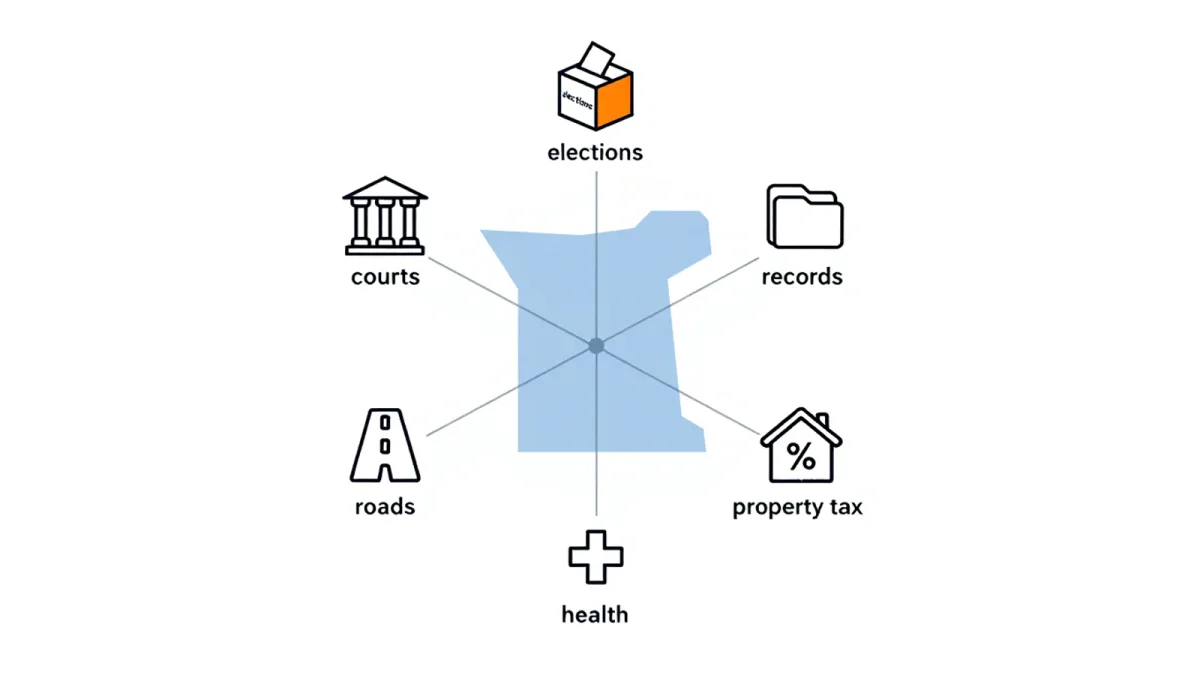
Exactly where a family matter is handled varies by state and county. In many places, county-level offices are involved in recording vital records, running social service programs, and hosting family courts. For a plain map of that layer of government, see what county governments actually do. A marriage license, a recorded certificate, and a divorce or custody case each tend to pass through a different office, so it pays to identify the function first.
Above the county sit state agencies, which administer family-related programs and license activities such as foster care in their state. Below and beside them sit nonprofit contractors and, in some places, other courts with their own procedures.
The federal role is narrower than many people expect. Washington sets baseline rules for some programs and provides funding, but it generally does not issue divorces, decide custody, or keep your marriage certificate. Family law remains largely a state matter, which is why answers differ across state lines.
How does a policy decision reach your household?
Consider a simplified example. A state legislature passes a law changing how support orders are calculated. A state agency then writes the administrative rules that turn the statute into a procedure a caseworker can apply. Those proposed rules are typically published for public comment before they take effect. We covered that step in How federal rulemaking works, and how to comment on a proposed rule. We covered a connected angle in How federal rulemaking works, and how to comment on a proposed rule.
Then the rule reaches a household budget. A support order is entered by a court and enforced by the state child support agency, so a change in the formula can change the number on the notice you receive. The route — legislature, agency rule, court order — means several stops sit between a bill and your budget.
The same chain applies to benefits. Eligibility definitions written in statute get translated into application forms, then into caseworker decisions, then into deposits or denials. Understanding the chain tells you which stop can actually fix your problem. A caseworker cannot rewrite a rule; a legislator cannot recalculate your individual order.
Why definitions of "family" vary so much between programs
Each program defines family for its own purpose. An immigration rule, a health insurance plan, an inheritance law, and a school enrollment form may each treat the same household differently. Merriam-Webster's entry on the word records how far the meanings range, from a household under one roof to a group united by common affiliation — and notes the earliest English sense of familia meant a household including servants, not just kin.
Modern usage surveys show the public is just as split. Research cited in the Wikipedia overview describes Americans giving a wide variety of answers when asked which household structures count as family, with some requiring marriage, some requiring children, and others accepting any group that functions as one. Agencies cannot operate on that kind of ambiguity, so they codify. The codified version is the one that governs your case.
Practical steps when you hit a definitional wall: read the definition section of the program's rules, which usually appears near the front; ask the agency in writing what definition it applied; and remember that a court, not an agency hotline, settles contested interpretations.
What this means for you
Our analysis of how these offices fit together points to three takeaways. First, there is no single "family affairs" counter. Identify the function — record a vital event, file a family court case, enforce a support order, apply for services — and you will be better placed to find the right office. Second, state lines matter. Family law and most family services are largely state-run, so a friend's experience in another state may not describe your process.
Third, the paper trail is public. Statutes, administrative rules, and court forms are published, which means you can read the rule that applies to you before you rely on someone's summary of it. For more coverage of agency machinery and intergovernmental questions, see the rest of our affairs section, and our broader programs coverage for how specific benefits work.
A note on our role: SocialGov is an independent publication, not a government agency or portal. We explain how the system works; we cannot process applications or make determinations in anyone's case. For an answer about your own marriage, custody, support, or benefits matter, the official channel is the county, state, or court office that handles that function in your state, and rules vary by state and change over time.