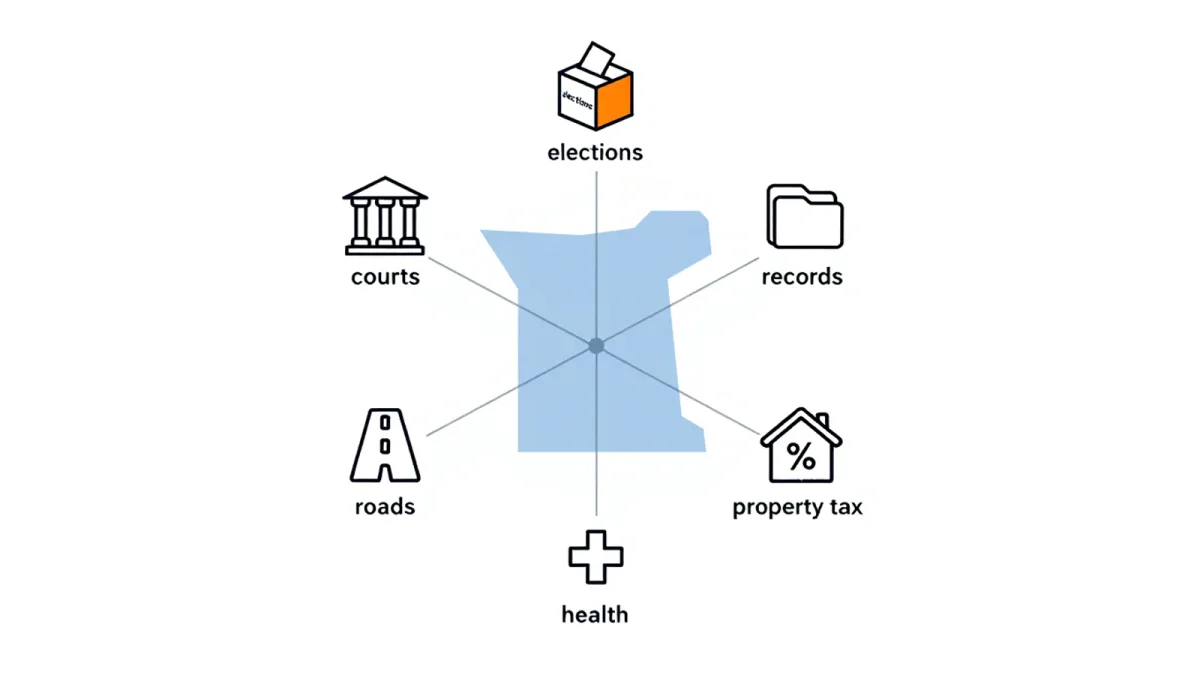
The United States has roughly 3,069 county governments, and they form the workhorse layer of local administration: counties record deeds, assess and collect property tax, conduct elections, run courts and jails in many states, maintain roads, and deliver public health services. Most people meet their county government three ways — a property tax bill, a visit to the recorder or clerk's office, and a jury summons — and rarely think about the rest. The National Association of Counties counts the jurisdictions and tracks their functions; as of 2026 no state had abolished its counties wholesale, though Alaska and Louisiana use different names and New England states have mostly dissolved county government above the town level.
What services does a typical county run?
The list is longer than most residents expect. Fiscal: property assessment and tax collection, budgeting, and often payroll for other local bodies. Records: deeds, marriages, births, wills, and court filings. Justice: many counties fund and house the trial courts, the sheriff's office, and the county jail, which holds most pretrial detainees nationwide. Infrastructure: county roads, bridges, and sometimes transit. Health: county health departments run clinics, restaurant inspections, and immunization programs. Human services: often administering state and federal benefits locally. Elections: in most states, county election offices register voters, run polling places, and count ballots — which is why certification stories are county stories.
Who runs a county government?
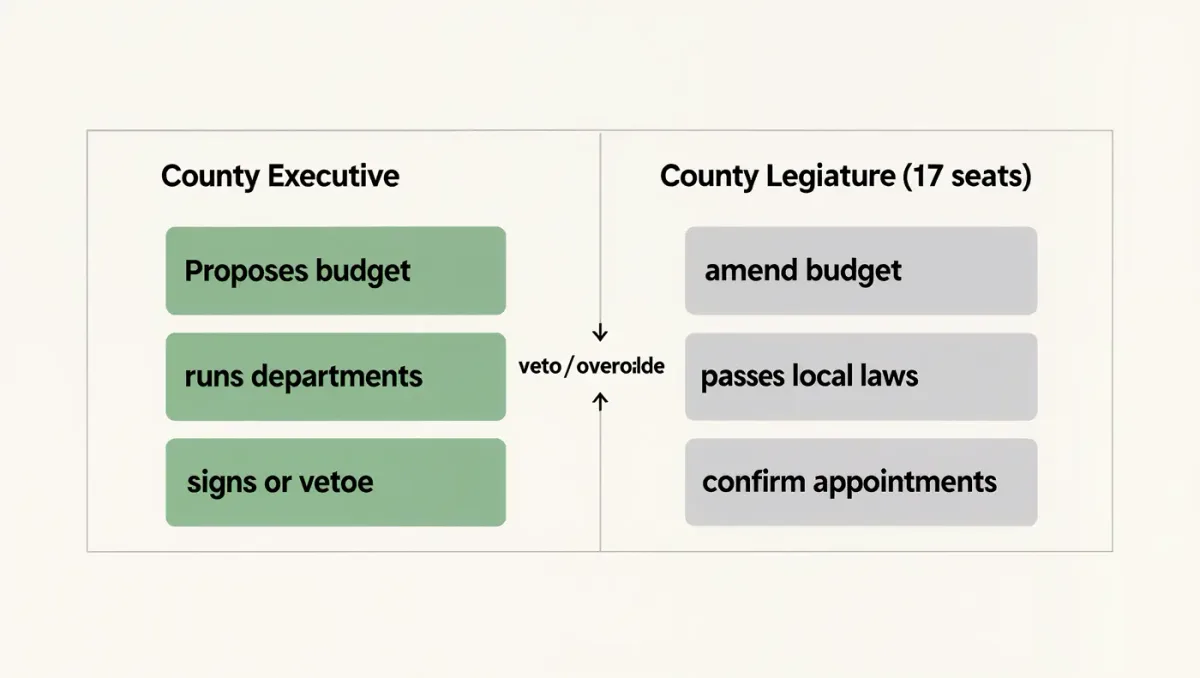
Structure varies by state, but two patterns dominate. The commission system elects a board — county commissioners, supervisors, or freeholders — that legislates and administers collectively. Many states add separately elected row officers: sheriff, clerk, treasurer, coroner, prosecutor, and assessor, each independently accountable. Larger counties adopt executive forms with an elected or appointed county executive plus a council. There is no uniform template; each state's constitution and statutes define what counties may do, and in some states counties are administrative arms of the state, while in others they hold broad home-rule powers adopted by county charter.
Where do counties get their money?
| Revenue source | What it funds |
|---|---|
| Property taxes | General fund: courts, sheriff, elections, administration |
| Sales and local option taxes | Capital projects, transit, jail construction |
| Fees and charges | Recording, permits, landfill, hospital services |
| State and federal intergovernmental aid | Highways, health, human services programs |
| Bonds and notes | Courthouses, jails, roads, other capital work |
Property tax is the backbone: the county assessor values each parcel, the board sets a rate within state limits, and the treasurer collects. Because assessment and collection are county functions even where schools receive most of the revenue, your property tax bill is usually a county document distributing money to several governments at once.
How do counties differ across states?
Geography and law produce wide variation. Louisiana calls them parishes, Alaska uses boroughs, and Connecticut and Rhode Island have no county government at all in the functional sense. County powers range from minimal — Delaware's counties primarily handle property matters — to the home-rule charters of large urban counties that operate hospitals, airports, and transit systems. City-county consolidations such as Denver, Jacksonville, and San Francisco have merged the layers entirely. Population range is equally extreme: the largest county by population, Los Angeles, has more residents than most states, while dozens of rural counties hold fewer people than a high school's enrollment, which strains their ability to staff courts and health departments.
What do counties NOT do?
Boundaries are real and worth knowing. Municipal zoning inside city limits is the city's job; public school districts are usually separate legal entities with their own boards and taxes, even when county residents assume the county runs the schools; and water and fire service may sit with special districts stacked on the map. A county commission cannot legislate for cities, set school curriculum, or regulate what a municipal police department does. The overlap confuses residents most during emergencies and elections, where counties execute functions the state mandates and cities depend on.
Who checks county performance?
Several mechanisms keep counties accountable, most of them local. Annual audits of county financial statements are required in nearly every state, and many are posted on county websites. State auditors and comptrollers review county compliance on state-funded programs, and grand juries in some states investigate county operations. The strongest check is electoral: commissioners, sheriffs, clerks, and assessors stand for election on staggered terms, and property tax caps give voters indirect control over the budget. Open records and open meetings laws apply to counties as public bodies, so agendas, contracts, and expenditures are public documents. County performance data on finances, courts, and health outcomes also appears in state and federal statistical series, which lets residents compare their county against similar ones.
What is a special district, and how does it overlap with counties?
Special districts are single-purpose governments — water, fire, hospital, transit, library, or cemetery districts — drawn on their own boundaries with their own boards and often their own tax or fee authority. The Census of Governments counts them in the tens of thousands, more than all counties and municipalities combined. Overlap is routine: a county resident may sit inside three overlapping water districts, a fire district, and a community college district, each sending a line to the same property tax bill. Districts matter to county watchers because they blur accountability — a service failure may belong to a district board that most residents cannot name — and because counties often act as the default sponsor or fiscal agent for districts too small to administer themselves.
How can a resident follow what their county does?
Almost everything is public and local: board of commissioners agendas and minutes are posted on the county website, budgets are published before adoption, and property records and tax bills are searchable. County meetings are where zoning changes, jail budgets, and election administration decisions actually get made — attendance at a two-hour budget hearing reveals more about where your property tax goes than any annual report. For records, the county clerk or recorder's site lists fees and online search tools; for elections, the county election office is the authoritative source for your registration, polling place, and results.