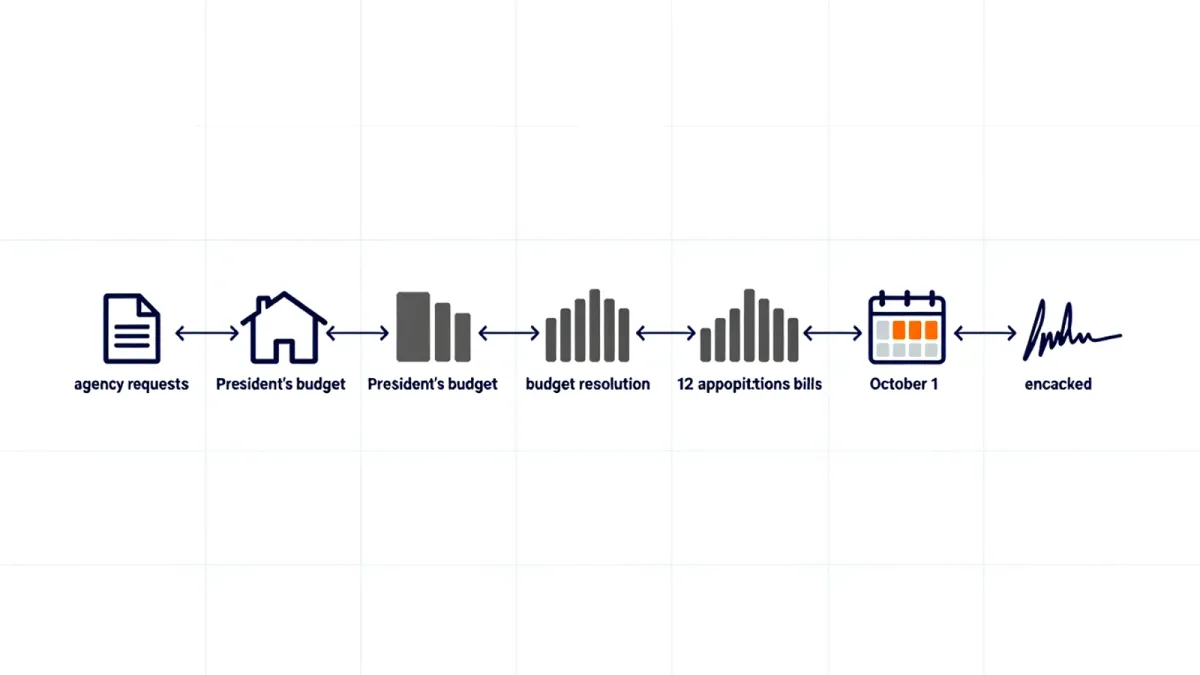
The federal budget process has two halves. The president's Office of Management and Budget assembles agencies' funding requests into a budget proposal, released on the first Monday of February, and Congress then writes the actual spending bills under its own rules. Lawmakers are supposed to finish those bills before the fiscal year starts on October 1; in recent decades they have regularly needed continuing resolutions to keep agencies funded past that date, and the annual deadlines have slipped further as the process has grown more contentious.
What is in the president's budget request?
Agencies start preparing requests more than a year ahead, in a cycle OMB calls the budget formulation. Each spring and summer, agencies draft what they want to spend the following fiscal year, OMB negotiates the numbers with them in the fall, and the result becomes the president's budget in February. The document contains proposed funding for each agency, tax proposals, and economic assumptions. It is a request, not a law: Congress is free to ignore every number in it, and often rewrites large portions. The president's budget still matters because it frames the debate and signals which programs an administration wants cut or expanded.
What does Congress do with the request?
Congressional budget work runs through the Congressional Budget Office, which issues independent cost estimates for legislation, and the House and Senate Budget Committees, which draft a budget resolution. The resolution sets totals for spending and revenue but is not sent to the president and does not fund anything. It works through a mechanism called 302(a), which allocates an overall discretionary total between the House and Senate Appropriations Committees. Each appropriations committee then divides its share among its twelve subcommittees in 302(b) suballocations. Those suballocations determine how much each subcommittee — from agriculture to defense to transportation — can put into its annual bill.
How do the twelve appropriations bills work?
Each of the twelve subcommittees drafts a bill covering the agencies under its jurisdiction, holds hearings with agency officials, and marks up its text. The full Appropriations Committee approves each bill before it goes to the floor. The bills cover discretionary spending — the money Congress renews annually — while mandatory spending such as Social Security and Medicare continues under standing law without annual votes. If Congress cannot pass the bills or a continuing resolution by October 1, funding for discretionary programs lapses and agencies must begin shutting down non-excepted activities under the Antideficiency Act.
What is a continuing resolution?
A continuing resolution, or CR, extends agency funding at existing levels for days or months while Congress negotiates the full bills. CRs usually freeze spending near prior-year levels and restrict new program starts, which agencies argue wastes money by preventing contracts and hiring they know are coming. When negotiations fail entirely, the impasse produces a shutdown. Congress also uses a separate tool called reconciliation, which lets one bill adjust taxes and mandatory spending with a simple majority vote in the Senate, bypassing the 60-vote filibuster threshold; reconciliation is not part of the annual appropriations cycle.
| Stage | Who acts | Typical timing | Product |
|---|---|---|---|
| Budget formulation | Agencies and OMB | Spring to fall, a year ahead | Agency requests |
| President's budget | OMB and the president | First Monday of February | Budget proposal |
| Budget resolution | House and Senate Budget Committees | April target (often missed) | 302(a) allocations |
| Appropriations | Appropriations subcommittees and committees | Summer | Twelve spending bills |
| Fiscal year begins | Congress | October 1 | All bills enacted, or a CR |
What is the difference between authorization and appropriation?
Two separate committees create two separate permissions, and the distinction explains many funding fights. Authorizing committees — Armed Services, Energy and Commerce, and their Senate counterparts — write the laws that establish and shape programs and can authorize spending up to a limit. The Appropriations Committees then provide the actual money, and agencies can rarely spend more than has been appropriated even if the authorization promises it. When an authorization lapses, a program does not automatically end, but it operates on borrowed legal time until Congress renews it. This double key also gives appropriators leverage: a program authorized at $500 million may receive a fraction of that in the annual bill, and nothing in the authorization forces the money out. Readers who want to know what an agency is legally permitted to do look at authorization bills; readers who want to know what it can actually afford look at appropriations.
Why does the process run late so often?
The deadline structure assumes agreement that often does not exist. The budget resolution is a concurrent resolution, so both chambers must pass identical totals, and partisan splits routinely prevent that. Without a resolution, appropriators still work from informal allocations, but the schedule slips. Congress has passed all twelve bills on time only a handful of times since the modern budget process was created in 1974; in most recent fiscal years it has relied on one or more CRs, sometimes into the following calendar year, and has increasingly packaged all twelve bills into a single law called an omnibus.
Where does the money go once it is appropriated?
Enacted appropriations give agencies budget authority — permission to obligate money — rather than cash up front. Agencies then apportion funds across the year through OMB, sign contracts and grants, and spend out over months or years. The Treasury tracks all of it, and the results appear in public reports: USAspending.gov shows awards and recipients, agency financial statements are audited annually, and the Government Accountability Office reviews whether agencies used funds as Congress directed. The debt limit sits alongside this process as a separate vote on borrowing to cover spending Congress has already enacted.
How can a reader follow the current cycle?
Start with the president's budget in February, then watch the CBO's analyses of the president's proposal and major legislation, and track the twelve bills on Congress.gov by searching appropriations. The House and Senate Appropriations Committees post subcommittee markups and bill text. CBO's regular baseline reports show how much the government is projected to spend, collect in revenue, and borrow under current law — the numbers to compare against whatever Congress finally passes.