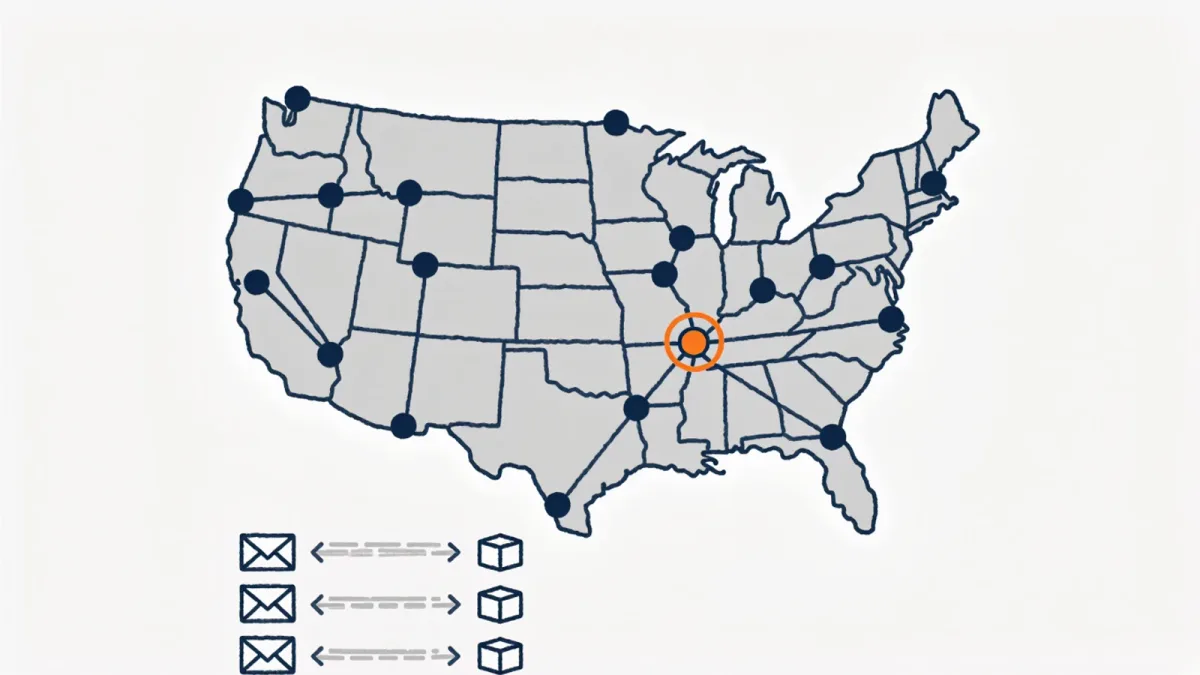
Letter writers get a rare piece of stability and shippers get a price increase. USPS announced on September 24, 2025 that it would not raise stamp prices for January 2026, leaving a First-Class Mail Forever stamp at 78 cents, while shipping services prices rose that same month, including about 6.6 percent for Priority Mail, per the agency's announcement. Behind the rate news, the network reorganization under the Delivering for America plan has continued to change how mail moves.
What changed?
Three operational shifts matter for customers. First, on July 1, 2025, USPS implemented the second phase of service standard refinements, expanding the geographic reach of two-, three-, and four-day standards for First-Class Mail and USPS Ground Advantage, per the agency's newsroom. In plain terms, more parts of the country fall into longer quoted delivery windows when mail travels farther. Second, the agency is rebuilding its processing network around large Regional Processing and Distribution Centers, with plans for roughly 60 RPDCs supported by local processing centers, per the USPS Office of Inspector General. Third, in February 2025 the agency began Regional Transportation Optimization, changing truck routing between facilities, over an advisory objection from the Postal Regulatory Commission.
Who is affected?
Anyone who mails or ships through USPS. Households see little immediate change for local letters, which remain within short standards. The people who notice the new network are those mailing across regions: a card from one coast to the other now more often falls into a three- or four-day standard rather than a two-day one. Small businesses using Ground Advantage and Priority Mail absorbed the January 2026 shipping increases, while stamp users saw none.
What should you do?
Check the quoted delivery standard, not the old habit, before choosing a send date: the Postal Service's online tools show the current standard for a specific origin and destination pair. For time-sensitive documents, use a service with a tracking and date guarantee rather than assuming a two-day arrival. Businesses that print postage in volume should recheck rates after each price change cycle, since shipping prices now adjust more often than stamp prices.
What this means for you
The 78-cent stamp is likely a limited-time bargain. Prices for mailing services were held for January 2026, but the agency has continued its pattern of periodic rate adjustments, so budgeting for eventual increases is prudent. Longer quoted standards mean the practical rule of thumb for cross-country first-class mail has shifted from two days to three or four, which matters for bill payments, ballots by mail, and correspondence with deadlines. When timing matters, send earlier than the old standard suggests or pay for a faster product.
SOCIALGOV is an independent publication and is not affiliated with the Postal Service. Current prices and delivery standards are published by USPS at usps.com, and the Postal Regulatory Commission's docket records oversight of network and rate changes.