USAspending.gov is the official public database of federal spending, run by the Treasury Department under the Federal Funding Accountability and Transparency Act of 2006. Its basic unit is the award — a specific contract, grant, loan, or direct payment to a named recipient — and as of fiscal year 2024 the site reported trillions of dollars in obligations across millions of awards each year. If you want to know who received federal money, for what, and under which agency, the trail ends at an award page on this site.
What is the difference between a contract and an award of assistance?
The site's data comes from two source systems, and the split matters for how you search. Contracts — the government buying goods and services — flow from the Federal Procurement Data System. Everything else, called financial assistance or "assistance awards," flows from agencies' payment systems into the Treasury system and includes grants, cooperative agreements, loans, direct payments such as Social Security, and other aid. A defense contractor's award and a university's research grant look similar on the site but carry different fields: contracts have vehicle and competition data, assistance awards have assistance listings — the catalog codes formerly known as CFDA numbers — that name the program behind the money.
| Field | Contracts | Financial assistance |
|---|---|---|
| Source system | Federal Procurement Data System | Treasury's award submission system via agencies |
| Examples | IT services, construction, supplies | Grants, loans, direct payments, block grants |
| Program identifier | Product or service code (PSC) | Assistance listing number (formerly CFDA) |
| Typical unit | Award, often split across modifications | Award, often with annual subdivisions |
How do I find a specific recipient's money?
Start at the search page and use the recipient filter rather than keyword guessing. Every recipient — a company, university, hospital, or individual — has a profile page aggregating all its awards, totals by year, and its top funding agencies. Recipient names are tricky: a corporation's parent and subsidiaries can appear as separate recipients, and the site flags some of these parent-child relationships. For a company, search the exact legal name, then check the profile's parent information. For a nonprofit or university, the site links multiple awards through a shared unique identifier, so one profile usually captures the whole picture. Each award page then gives you the deeper paper trail: the award amount and its base versus obligated amounts, the place of performance, competitive status, and, for contracts, links to the actual solicitation on SAM.gov.
What does "obligated" mean, versus "outlayed"?
Obligations are promises: the government has committed money to an award, whether or not cash has moved. Outlays are actual payments over time as work happens. A ten-year grant might show full obligations on day one and outlays trickling in for a decade, so the two figures for the same award rarely match in any given year. When you read a total on USAspending, check which measure it is — news reports and audit findings often cite obligations, while budget discussions often cite outlays, and the gap explains many apparent contradictions.
What are the site's known limits?
A few, and knowing them prevents wrong conclusions. Subawards — money a prime recipient passes to subcontractors and subgrantees — are reported by the prime, with reporting thresholds and known underreporting, so subaward totals understate reality. Agencies submit their own data, and the site carries the Government Accountability Office's repeated findings of incompleteness in certain agencies' reporting. Some programs, notably most tax expenditures and certain national security activities, are not on the site at all. And a recipient's award on USAspending is not the same as its total federal relationship, which may include programs outside the reported systems.
Can I download the raw data?
Yes, and this is where the site is most useful beyond casual lookup. The custom download feature lets you pull award-level rows for an agency, program, or recipient as a file you can open in any spreadsheet. For heavier work, the site publishes a public API and a monthly archive of complete data snapshots. If you want to see what journalists and auditors see, download one agency's contracts for a year, sort by obligated amount, and start at the top — each row links to the award page, and each award page is where the accountability questions begin.
What is the Data Lab?
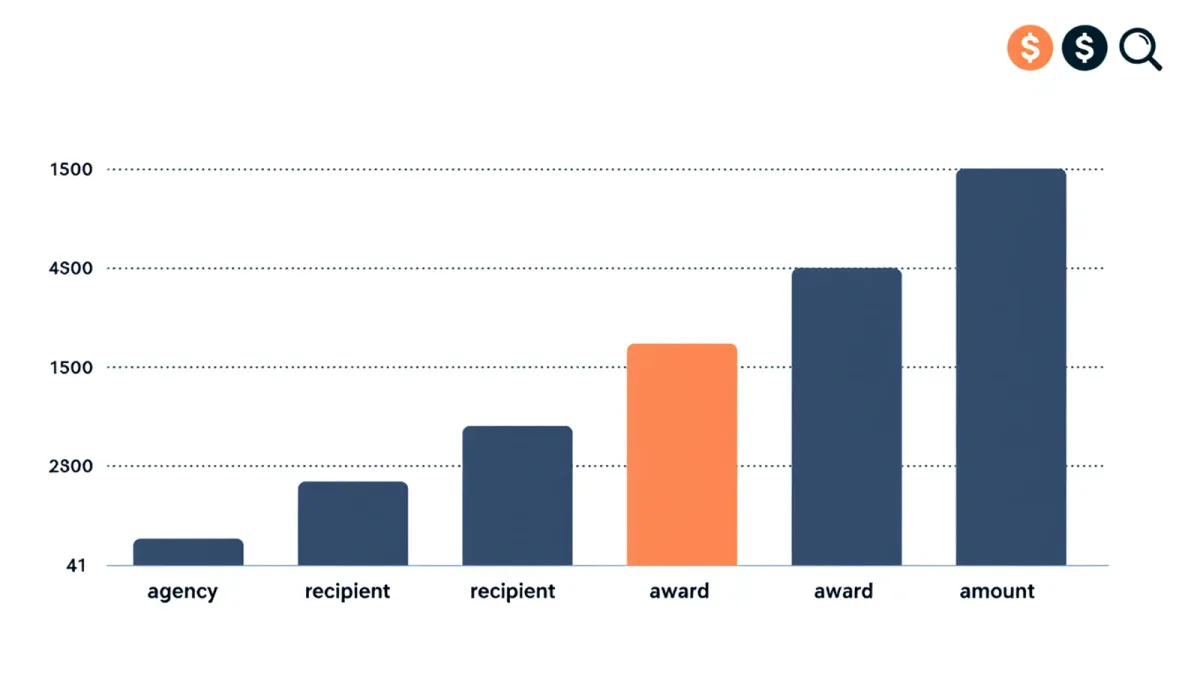
USAspending's analytical companion, the Data Lab, turns the raw award data into explainable visual profiles: agency spend-down curves showing how fast agencies obligate their budgets through the year, state-level maps of federal spending, profiles of the largest recipients, and breakdowns of spending by category. Each visualization links back to the underlying award data, so you can move from a chart to the individual awards behind it without rebuilding the query yourself. It is the fastest way to orient if you do not yet know which agency or program you are looking for, and every chart names the filters that produced it so you can reproduce the numbers.
How far back does the data go?
Coverage depends on the award type. Contract data reaches back to the 1980s through the procurement system, while the full picture of financial assistance improves sharply after the Transparency Act's reporting deadlines took effect around 2008. Pre-2007 assistance data is uneven, and subaward reporting only began in the 2010s, so long-run trend comparisons across award types are approximations rather than clean series. The site marks its data as subject to revision — agencies correct submissions after publication — so a figure you pull today can change slightly in the next monthly archive.