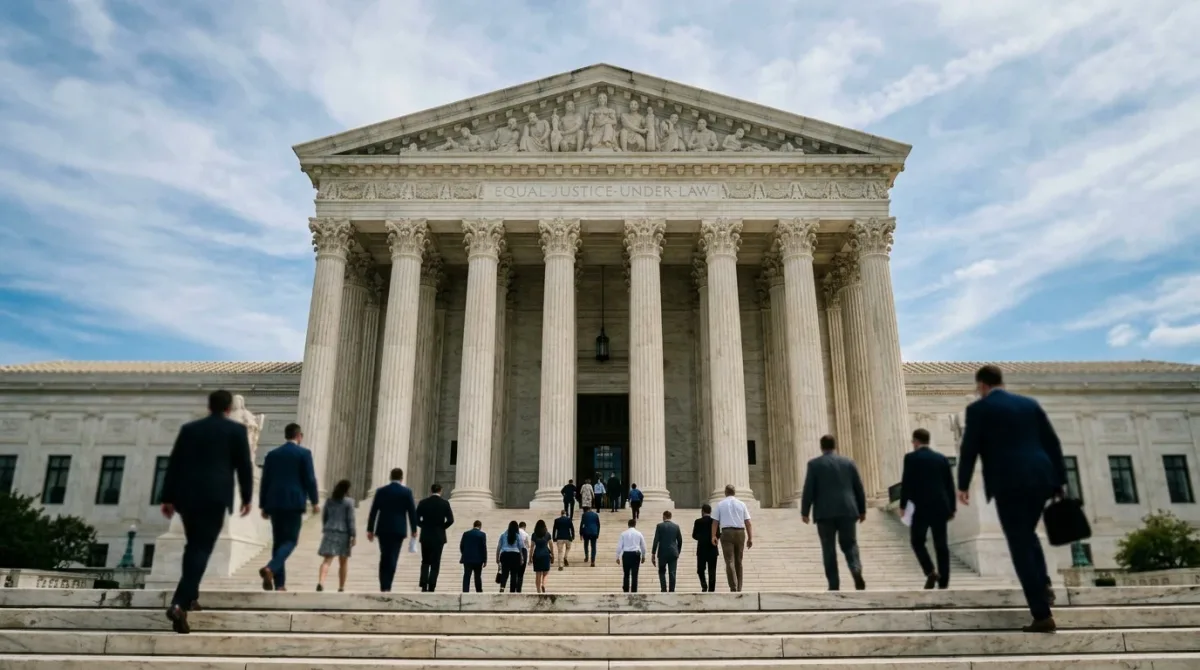
The Supreme Court ruled 6-3 on June 27, 2025, that federal district courts generally lack the authority to issue nationwide, or "universal," injunctions blocking government policies for people who are not parties to a lawsuit, a decision that reshapes how litigants can challenge federal action across the country.
What Did the Supreme Court Decide?
In Trump v. CASA, Inc., the Court held that universal injunctions "likely exceed the equitable authority that Congress has given to federal courts" under the Judiciary Act of 1789. Writing for the majority, Justice Amy Coney Barrett said relief ordered by a district court must be limited to the plaintiffs actually before it, rather than extended to everyone in the country who might be affected by the challenged policy. The Court granted the government's request for a partial stay of three lower-court injunctions that had blocked President Trump's birthright citizenship executive order nationwide, narrowing those orders to the parties with standing to sue.
What Prompted the Case?
The dispute reached the Court after three federal district courts issued nationwide injunctions halting enforcement of Executive Order 14160, which sought to deny automatic citizenship to children born in the United States when neither parent is a citizen or lawful permanent resident. Individual plaintiffs, advocacy organizations and state governments argued the order violated the Fourteenth Amendment's Citizenship Clause and the Nationality Act of 1940. The administration did not ask the Court to rule on whether the birthright citizenship order itself was constitutional. It asked the justices only to decide whether district judges had the power to block the policy for the entire country rather than just the plaintiffs who sued.
How Did the Justices Divide?
Justice Barrett wrote the majority opinion, joined by Chief Justice John Roberts and Justices Clarence Thomas, Samuel Alito, Neil Gorsuch and Brett Kavanaugh. Thomas and Gorsuch filed a concurrence describing "complete relief" for plaintiffs as a ceiling on remedies, not a mandate to go further. Alito and Thomas separately warned against using class actions or state third-party standing to recreate the effect of a nationwide injunction. Justice Sonia Sotomayor dissented, joined by Justices Elena Kagan and Ketanji Brown Jackson, and read her dissent from the bench — a step justices reserve for the strongest disagreements. Jackson filed a separate dissent arguing courts must retain the power to order government-wide compliance with the law.
What Can Courts Still Do?
The ruling does not eliminate broad relief in every case. The Court's opinion described "complete relief" for named plaintiffs as the outer limit of what a district court may order, meaning judges can still fashion remedies broad enough to fully protect the people actually suing, but not broader. The opinion left open other paths to nationwide effect, including class-action lawsuits certified under Federal Rule of Civil Procedure 23 and, in some circumstances, suits brought by state governments, while the Alito-Thomas concurrence cautioned against using those tools simply to evade the ruling. Attorney General Pam Bondi said the decision means district courts must "stop the endless barrage of nationwide injunctions" against administration policies, PBS NewsHour reported.
What Happens Next for Birthright Citizenship?
The Court's decision was procedural: it did not resolve whether the birthright citizenship order is constitutional. The justices gave the lower courts 30 days to reconsider their injunctions under the narrower standard the Court laid out, and the executive order could not take effect during that window, NPR reported, leaving room for further litigation, including potential class-action claims, before the underlying constitutional question is decided. PBS NewsHour reported that the ruling left open the possibility the birthright citizenship changes could remain blocked nationwide if plaintiffs pursue relief through a certified class action.
How Common Were Nationwide Injunctions Before This Ruling?
Nationwide injunctions were rare before the 1960s and became far more frequent over the past decade, Notre Dame law professor Samuel Bray told NPR, describing their rise as "meteoric." Their use grew alongside a rise in litigation challenging executive orders issued by presidents of both parties, including Barack Obama, Trump and Joe Biden, according to NPR. During Trump's second term, district courts had issued nationwide injunctions blocking other administration policies beyond the birthright citizenship order, including a directive recognizing only two biological sexes for federal purposes and a Department of Homeland Security policy change on immigration enforcement at houses of worship, NPR reported. Thomas, Gorsuch and Alito had criticized universal injunctions in earlier opinions; Thomas has called the practice "legally and historically dubious" because it was largely unknown in federal courts before the 1960s, according to NPR.
What Comes Next in Litigation Strategy?
Legal scholars expect the ruling to push challengers of federal policy toward different procedural tools. Bray told NPR the decision will "remove universal injunctions as the default remedy in a challenge to executive action" and said he expects more litigants to pursue class-action lawsuits instead. Florida State University law professor Michael Morley predicted that certifying nationwide plaintiff classes under Rule 23 will become "the next major battleground" in litigation against the federal government, alongside increased reliance on state-led lawsuits and organizational or associational standing claims, NPR reported.
Why Does This Ruling Matter Beyond This Case?
Nationwide injunctions had become a routine tool in litigation against the federal government under both Democratic and Republican administrations, allowing a single district judge to pause a policy for the entire country while a case proceeded. By curbing that practice, the Court narrowed how quickly and broadly future plaintiffs — of any political stripe — can freeze a federal policy nationwide through a district court, shifting more weight onto class-action certification, state-led suits and eventual circuit-level or Supreme Court rulings to achieve nationwide effect.
For a related politics perspective, read Ben Affleck and Matt Damon Make a Splash on Gossip Stone TV.
For more context, read FTC Orders Shut Down Unauthorized Billing and Credit Card Laundering Schemes, Require Turn Over of Assets Valued at Approximately $40 Million.
For more context, read american.